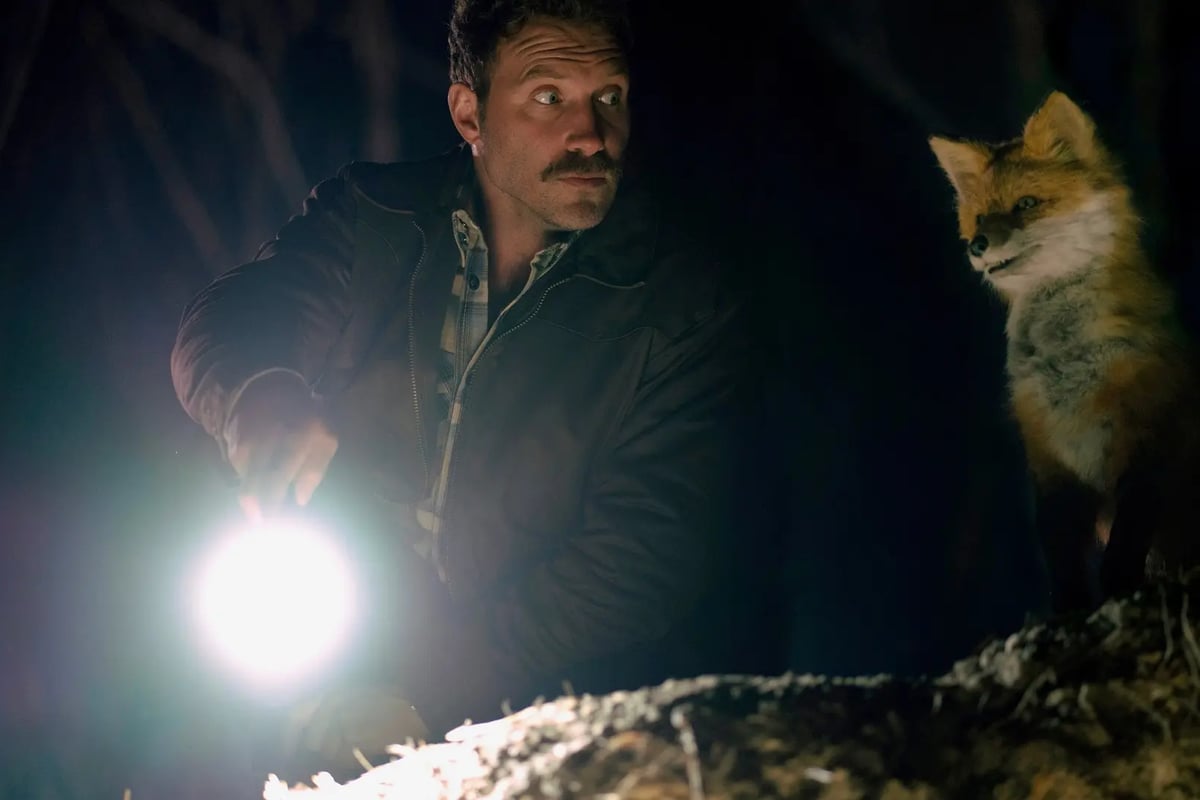
Known for cult retro-absurdist hits like Danger 5 and Italian Spiderman, Adelaide filmmaker Dario Russo takes a darker, more restrained turn with his debut feature, The Fox. Starring Jai Courtney, Emily Browning and the voice of Olivia Colman, the film blends laconic Australian humour with East Asian folklore. It follows a dissatisfied heir who is convinced by a talking fox to push his unfaithful fiancée into a magical pit to “fix” her. Tonally, it lands somewhere between The Castle and Death in Brunswick, with a distinctly 1970s vibe.
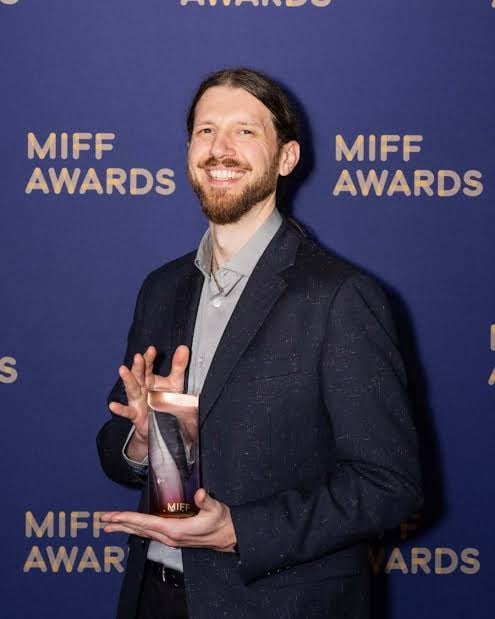
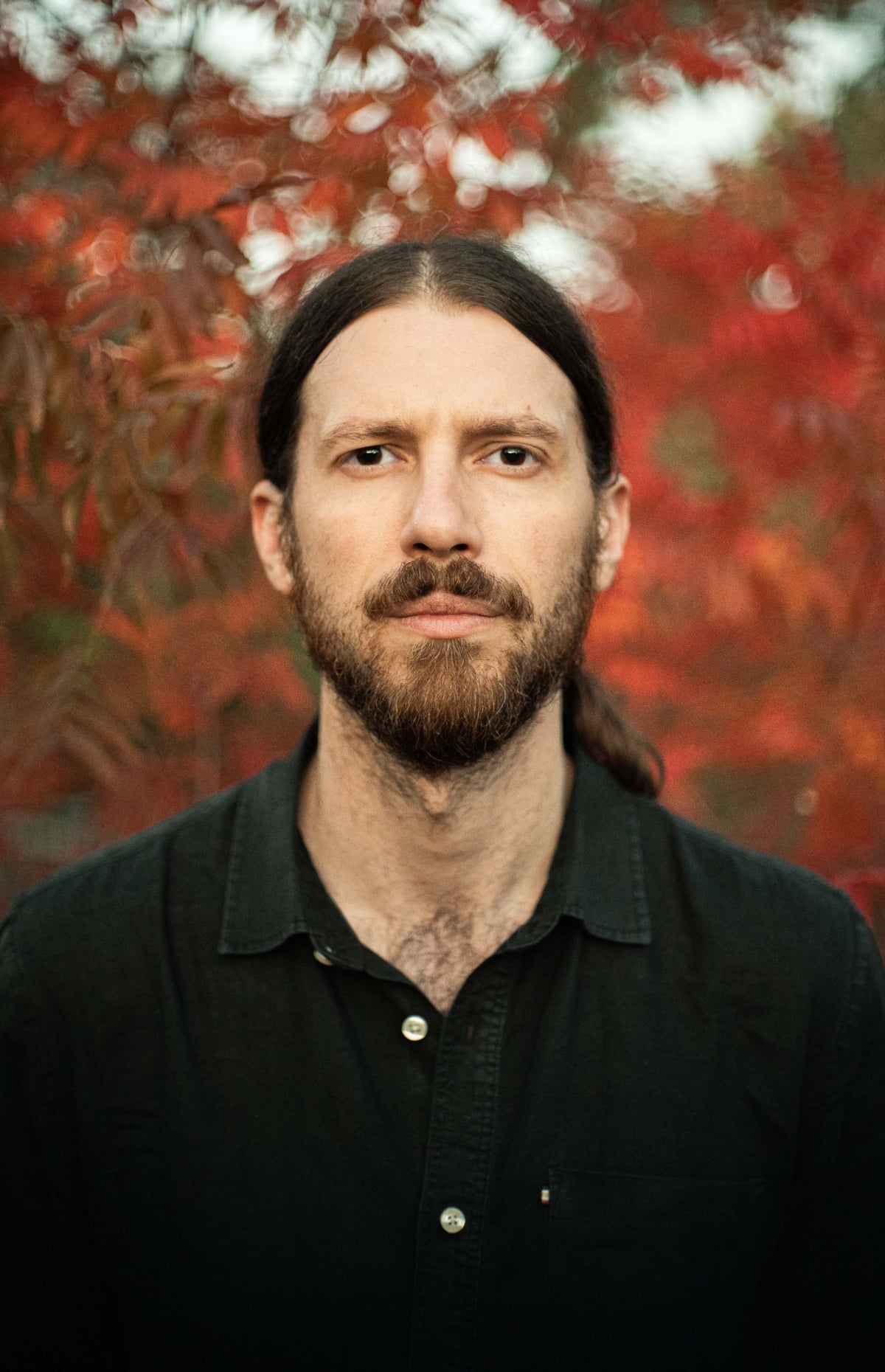
Ahead of its Australian cinema release, David Jobling sat down with Russo to discuss 1970s cinematography, dark comedy and scoring a movie with ancient Celtic war horns.
Channelling the 1970s and Gordon Willis
David: I had a look at The Fox and really enjoyed it. I’m a big fan of Ira Levin – the writer of Rosemary’s Baby and The Stepford Wives – and that whole era of 1970s social satire and horror. I got a strong feeling that was going on in your head as you wrote the script and made the film. There’s a real seventies feel to it. Do you agree, or am I barking up the wrong tree?
Dario Russo: Nah, you’ve nailed it. It’s very informed by a 1970s sensibility. I love 1970s cinema – Rosemary’s Baby in particular is a big reference point. Another one, slightly earlier from the late sixties, is an Australian reference point: Wake in Fright, which was a British production shot in Australia and directed by a Canadian. So, the Commonwealth! I love that austere, minimalistic 1970s cinema language, as well as the themes of social satire and social claustrophobia that turn up over and over again in movies from that decade.
David: You managed to capture the era visually, too. There was nary a handheld camera in sight. No chasing the fox through the bushes – just the camera rising slowly over the magical hole. It’s remarkably still. Did you share this style choice with the cast, or just tell them to say what’s on the page and have some fun?
Dario: A bit of both. In terms of the coverage – which nobody else has really picked up on yet – there’s basically no camera movement in the whole film, and that was intentional. I wanted it to feel very minimalistic and locked-off on sticks, again informed by that 1970s methodology. I really love anything shot by Gordon Willis.
Willis, a legendary American cinematographer known as the “Prince of Darkness”, defined the visual language of 1970s New Hollywood through his shadowy, naturalistic work with directors such as Francis Ford Coppola and Alan J. Pakula.
Dario: The lighting was heavily informed by Gordon Willis – that All the President’s Men, The Godfather and Klute kind of look. Lots of practical light sources. All of that was in service of the fact that I never wanted this movie to feel whimsical. I wanted the comedy to come from a plausible genre universe that feels serious within its own world, even though the parameters are completely insane. I never wanted it in the realm of elevated Wes Anderson whimsy. It needed to be a darker cinematic world with fantasy elements.
When it came to the performances, I told the actors, “This is my coverage – it’s going to be very simple and standard: master shots and singles.” That gave me the opportunity to build comedy in the edit through rhythm. In many sequences, it’s just one locked-off shot and the entire scene plays out as is, which actors love because they simply get to act the scene.
Coercion, folk tales and walking the line
David: Those single shots of Heather Mitchell and Miranda Otto are wonderful – you just look in their eyes to see what’s going on inside their heads. I think The Fox is horror dressed up as lamb. It reminded me of The Wicker Man, where sinister, pseudo-whimsical characters trot about in masks before burning someone to death on an island. Part of me thought you could have pushed it even further, especially after clocking those bones at the bottom of the magic hole.
At the same time, I’ve seen a few reviews taking issue with the premise, given Australia’s current crisis around violence against women – questioning a comedy about pushing an unsatisfactory partner into a pit to improve her. Without giving away spoilers, how do you feel about that criticism?
Dario: The film deals with control and coercion within relationships. It’s a dark comedy that explores some uncomfortable truths about how we get involved with others romantically. Yes, Jai Courtney’s character pushes his fiancée, played by Emily Browning, down a hole – that happens pretty early, so it’s no spoiler. He’s been promised by a talking fox, voiced by Olivia Colman, that it will turn her into the perfect partner.
That in itself is an act of violence, of course, but none of his behaviour is condoned. By the end of the film, he is seen as a ridiculous figure who does terrible things while in deep self-denial, doubling down on his psychological malfunction. This isn’t a movie that celebrates controlling your partner or forcing them into a mould to suit you. It explores what that actually means and how people do it, using folk tale and humour to give people something to think about. If someone is offended by dark comedy, they might take issue with it, though that’s certainly not my intention.
David: I agree wholeheartedly – it’s a healthy way of examining those ideas. We live in an era where Cinderella adaptations like Into the Woods and The Ugly Stepsister show a stepsister getting her foot hacked up to fit a glass slipper. Your film is a Grimm’s fairy tale in so many ways, which is why part of me would have loved to see a touch more of that splashy Danger 5 energy.
Dario: See, this is a modern folk tale for grown-ups with talking animals in it. As you mentioned, the Brothers Grimm stories were originally shared by adults and dealt with emotional concepts relevant to adults. Over time, they were Christianised and sanitised into bedtime stories for children.
In essence, the folk tale is an incredibly primal format for communicating psychological ideas. Horror movies are our contemporary version of the folk tale, taking an emotional problem and manifesting it in a supernatural way. The Fox comes from that lineage. I could have made a bleak version that delved even deeper into the horror, but I chose to swing the tone towards a Coen brothers-esque black comedy. I didn’t want people walking out of the cinema feeling completely destroyed emotionally.
Magic realism and generational baggage
David: Do you think magic realism is a space you’ll stay in for a while?
Dario: I’m still very inspired by the vernacular of the folk tale – taking the ordinary world, twisting the rules by X per cent, and seeing how things go. At the same time, I don’t want to pigeonhole myself as “the wacky folk tale guy” or “the talking animal guy”, as much as I love it.
What excites me about magic realism in an adult context is that it wakes up a sense of childhood wonder that sits dormant in all of us. By placing it in a grown-up world, you’re trying to reinvigorate a bit of magic. Maybe that’s the magic I’m looking for in my own life.
David: I’d love to see The Fox on a double bill with Harold and Maude. It has that understated late-sixties, early-seventies humour – like The Fearless Vampire Killers or Bedroom Mazurka – where you watch it with someone, waiting to see if they’ll laugh or if it’ll go over their head. You say it’s for adults, but who is it really for? Is there a tribute to your own mum and dad tucked inside?
Dario: Unexpectedly, yes. I started writing it from my own perspective as a millennial, thinking it would resonate most with people in my age bracket. But as I developed the relationships between Nick and his dad – played by Frankie J. Holden – and Kori and her dad, played by Zlatko Burić, I realised it’s also about intergenerational baggage and the communication gap between parents and their adult children.
Both of my parents are actually in the film. My dad plays Mercorella the farmer – he also famously played Hitler in Danger 5 – and my mum is getting her hair cut in the background of the hairdresser scene. Part of the crisis of growing up is realising how similar you are to your parents. Every day I’m shocked when I do something and think, “I know exactly where that came from.” A big part of the movie is reflecting on that in the most extreme way possible.
Sheet music, silence and the Celtic carnyx
David: When you sit down to write, are you already editing the final film in your head – thinking through shot sequences and that extraordinary music you put together?
Dario: My brain works musically overall, so the script is like sheet music for the movie. I structure my action lines so that one sentence basically equals one shot. I see writing, directing and editing as a single job, especially with comedy, where timing is everything – there are literally single frames that make a joke land or miss.
As for the music, I didn’t know what I wanted until quite late, except that I wanted the score to be sparse. For most of the film, there is no score whatsoever. That harks back to the seventies, or to modern films inspired by that era like No Country for Old Men, which is scoreless all the way through. I love it when scenes are allowed to breathe without music patronising the audience and telling you how to feel – especially in comedy. Comedy music is horrible.
Instead, I asked what element of the story hadn’t been manifested yet, and it was the primal, eerie magic of the mythological world underneath it all. My wife went on a Celtic music history kick on YouTube and stumbled across footage of a Scottish musician named John Kenny playing an ancient Iron Age war horn called the carnyx. We licensed a bunch of his recordings, and I paired them with Japanese taiko percussion that I composed using software, nodding to the film’s East Asian folklore roots.
That minimalist percussive approach drew inspiration from Kaneto Shindō’s 1964 Japanese folk-horror classic Onibaba, famous for its stark black-and-white imagery and sparse, unsettling taiko drum score.
Dario: In The Fox, the music is tied strictly to the pit. The score only really shows up when there’s activity around the hole, almost as if the magic is seeping out of that space. It’s fox business, really.
The Fox opens in Australian cinemas on 26 November 2026.
About the author: David Jobling has written for Australian Screen Education and Metro Magazine and has worked as an actor with directors such as James Frawley, Rolf de Heer, Luke Shanahan, Michael Kantor, Janusz Kamiński, Georgina Willis, Donald Crombie and Ken Hannam.
Follow Fifty+SA on Instagram and Facebook, and subscribe to our weekly newsletter.