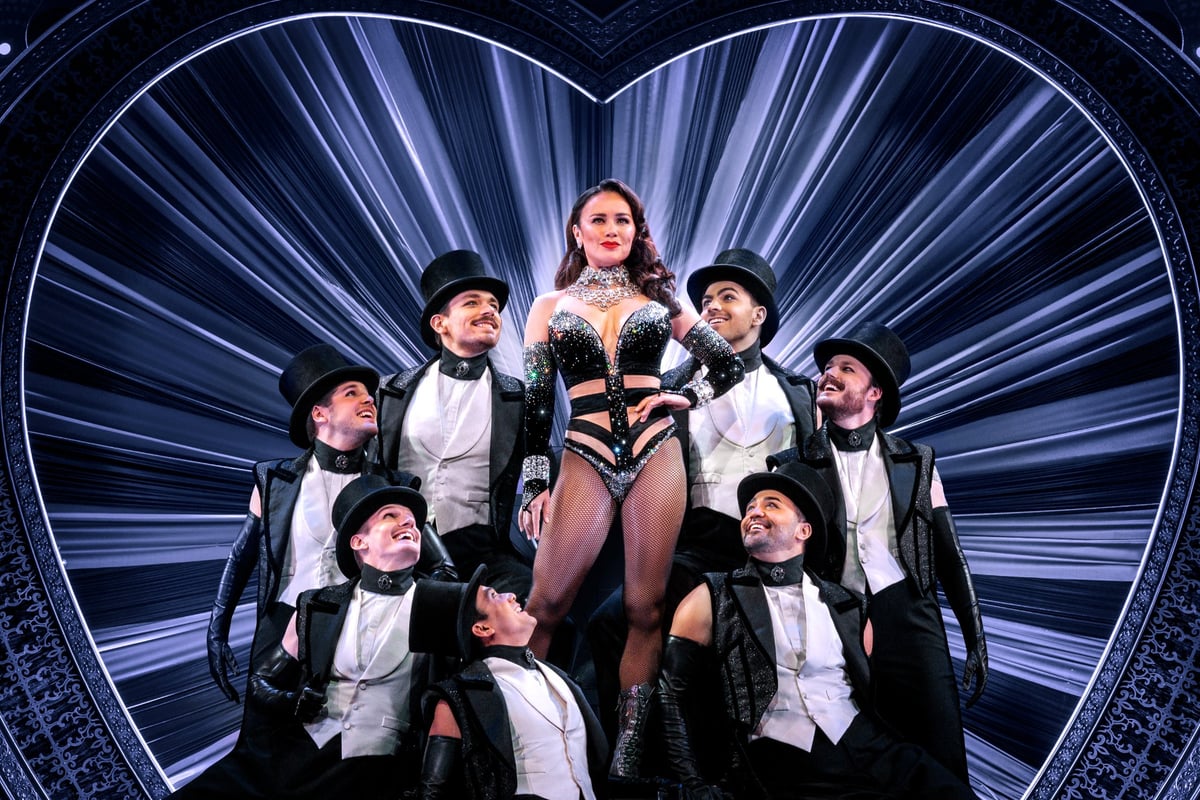
State Opera South Australia’s brand-new production of Carmen, which opened Saturday night, 17 October 2026, at Her Majesty’s Theatre, serves as a triumphant grand finale to the company’s Golden Jubilee mainstage season. As State Opera Artistic Director and Conductor Dane Lam pointed out in his pre-show greeting to the audience, Bizet’s music from Carmen has been thoroughly absorbed into popular culture over the 151 years since its premiere. Consequently, many people have heard these famous melodies completely out of context, knowing them merely for their catchy, enjoyable feel. This immense cultural footprint is further reflected in cinema history, with more than 80 film adaptations based on the story of Carmen, making it one of the most frequently adapted literary and operatic works ever captured on screen. Because these tunes are so deeply hardwired into our collective memory, the orchestral delivery must be exact, crisp, and thoroughly enlivened to keep them feeling vital. Under Maestro Lam’s precise dictate, the Adelaide Symphony Orchestra achieves this splendidly well indeed, breathing dynamic energy into every iconic bar.
The Maestro also imparted the little-known fact that State Opera sets in the past have often ended up being carted and dumped into landfill, simply because the company lacks the infrastructure or capital works capacity to store such massive items en masse. Yet, in a striking gesture towards sustainability, Ailsa Paterson’s “maximalist-surrealist” production design was created from recycled elements of previous stagings. This eco-conscious approach allows her new design to rise phoenix-like from the remnants of the old, manifesting as an entirely unique visual interpretation.
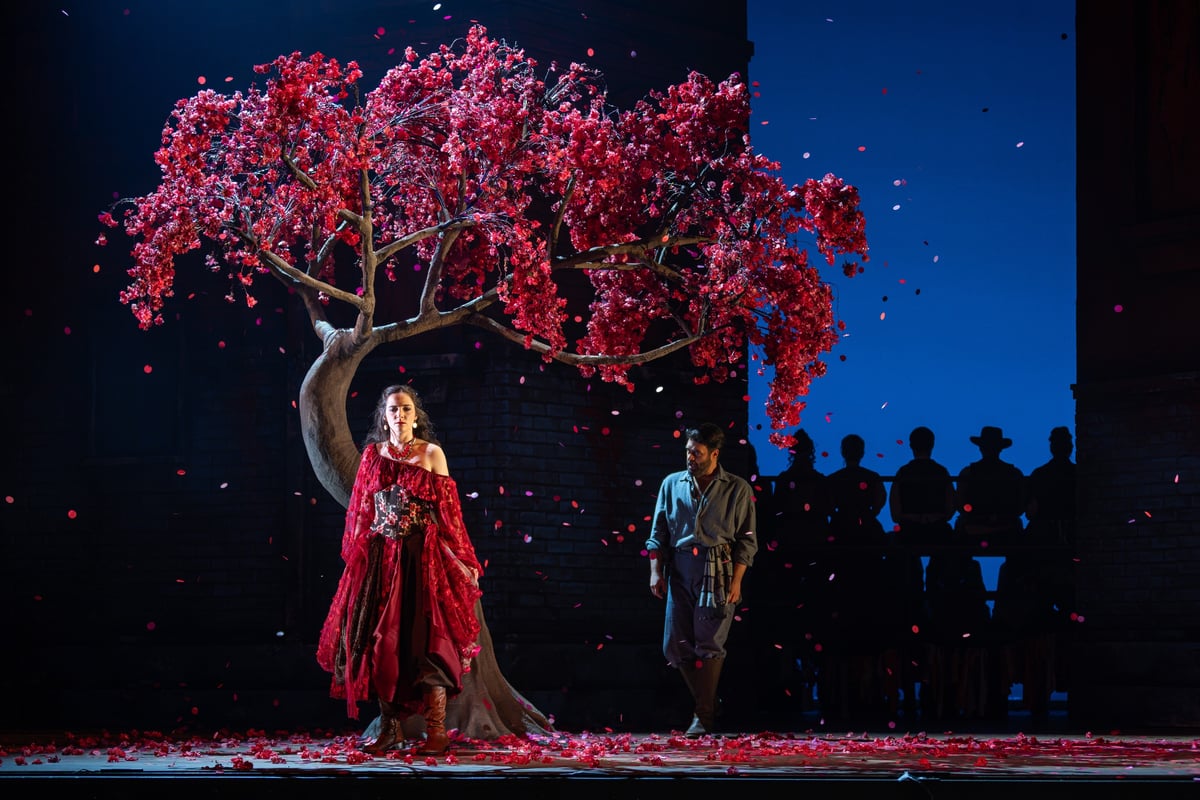
On stage, a twisted Sweet Acacia (Vachellia farnesiana or Acacia farnesiana) tree abundant with scarlet-red flowers, which periodically float in the breeze or carpet the ground, sits beside a monumentally large tobacco factory. This choice represents a brilliant bit of conceptual dramaturgy; historically, Bizet operated on a romanticised French literary imagination of a country he never actually visited, turning Mérimée’s real-world Spanish yellow mimosa blossoms into the operatic “fleur de cassia”. Designer Paterson cleverly leans into this poetic license, painting the tree’s blooms a deep, crimson red to serve as a bloody visual metaphor for the violent passion to come. This same tree remains in every scene, suggesting the species is common around the environs of Spain (which it is), and many characters on stage interact with its blooms in loving or hopeful gestures. Consequently, the tree becomes a stunning motif of hopes, longings, and wishes. Director Hansford incorporates the tree naturally into the action, making this a highly successful blending of direction and design.
While everything at street level is washed in a beautifully fresh Cobalt Blue (or a closely related pigment known as “Spanish Blue”), flooding from above is a visceral deep red that vividly expresses how the volatility of romance may become gushing blood at any moment. This specific danger is demonstrated deftly in the first few moments of revelation: as the audience first glimpses this extraordinary world, the action on the street involves a woman being rescued from soldiers, only to be kissed and then promptly pushed to the floor by her rescuer, a chilling piece of foreshadowing, as well as a clear marker of exactly what is at stake in this place.
That monumentally large tobacco factory in turn shifts to reveal Lillas Pastia’s tavern, gritty back alleys, and the rugged, dangerous mountain pass where the smugglers have set up camp, the latter plunged into an inky darkness beautifully realised by co-lighting designers Bernie Tan-Hayes and Mark Oakley, before ultimately opening up to the exterior of the grand bullring. This Oakley/Tan-Hayes lighting design works hand-in-hand with the sets, frequently shading an illusion of distance, blue skies, and lazy sunsets, while even subtly changing the foliage of the tree from a blush pink through to the crimson red.
As the number one most-performed French-language opera in history, Bizet’s masterpiece is universally recognised for its tragic story of mismatched love. Yet, its emotional architecture is anchored in Henri Meilhac and Ludovic Halévy’s original libretto, which relies heavily on sharp wit, quick-paced dialogue, and systemic irony. At its 1875 debut at the Théâtre de l’Opéra-Comique, the classification of “opéra-comique” was a structural definition, meaning spoken dialogue connected the scenes rather than continuous singing, rather than an emotional one. Tragically, this misunderstood premiere left Bizet to die three months later at just 36 years old, convinced his work was an absolute failure after a critical disaster of a season where the press heavily condemned the plot, the audience was deeply distressed, and the music itself was neither liked nor appreciated. In this fresh staging, director Laura Hansford brilliantly allows that inherent humour and playful cynicism some much-needed space, breathing vibrant new life into the familiar classic by honouring its witty, theatrical roots.
Hansford’s production highlights the fact that this is not just a story of inconvenient love, but fundamentally incompatible love. The tragedy stems from a catastrophic clash of values: Don José treats love as a contract of ownership, while Carmen views it as an expression of absolute autonomy. Indeed, autonomy is Carmen’s defining characteristic; when she sings that love is a “rebellious bird”, she is stating that her affection cannot be bought, governed, or legally bound. Conversely, José believes that because he sacrificed first his freedom and then his career for her, he essentially owns her loyalty. Carmen fiercely protects her freedom, ultimately choosing to fight in the final scene rather than surrender her right to choose how she lives and who she loves. To her, a life without absolute self-governance is not worth living. For this high-stakes dynamic to succeed, the emotional pitch between the two leads must be spot-on. Their physical relationship shifts seamlessly from early comedic flirtation, through intense passion, and finally into a cold indifference on Carmen’s side, a transition Charlotte Kelso handles with natural panache in a celebrated, triumphant homecoming to the South Australian stage. Gerard Schneider is entirely on board emotionally, demonstrating his character’s psychological dexterity (or tragic lack thereof) in a way that allows him a raw vulnerability that eventually curdles into murderous rage, no easy dramatic feat.
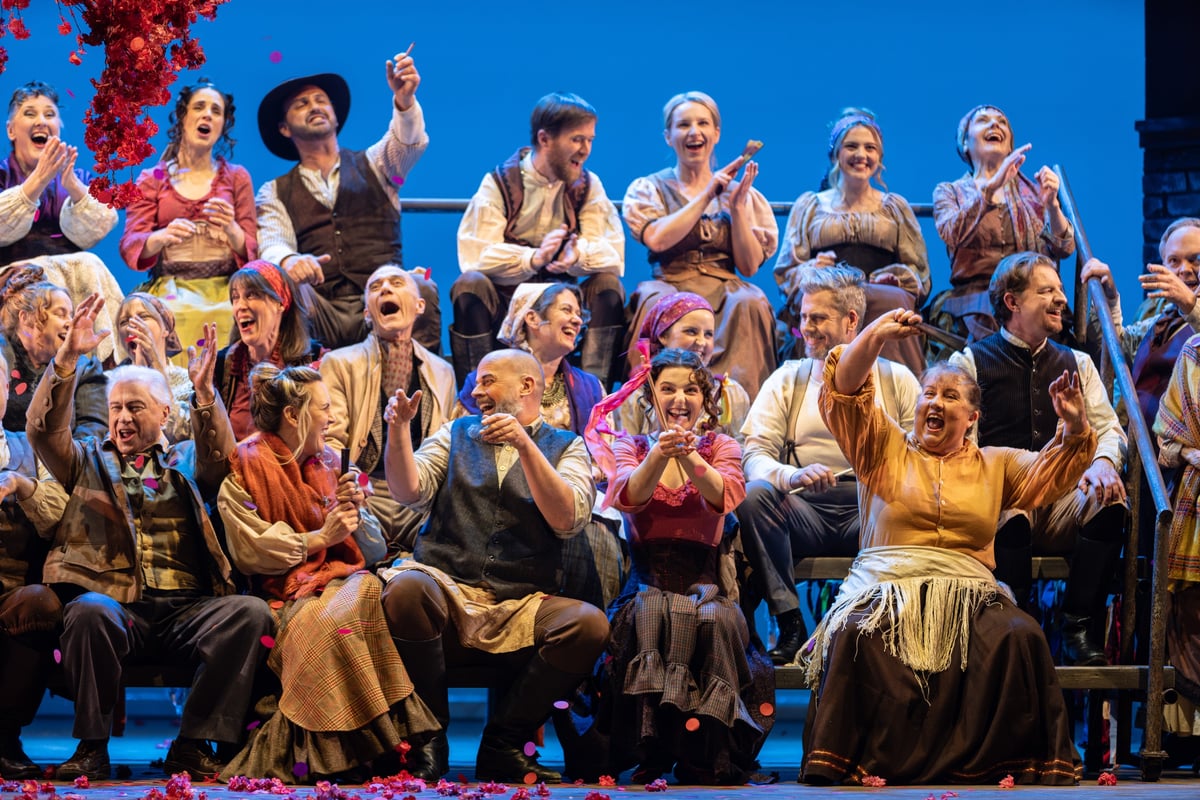
Musically, the evening serves up a sumptuous succession of operatic high points, anchored by the exceptional vocal delivery of the entire ensemble. Kelso’s seductive command of the famous “Habanera” establishes Carmen’s unyielding terms from her very first entrance. Micaëla (Desiree Frahn) arrives, sent by Don José’s mother to bring him a kiss. Frahn is the perfect embodiment of pastoral values away from the complicated city; her song conveys an innocence and purity that temporarily renders onto José’s heart, culminating in her magnificent Act 3 aria, “Je dis que rien ne m’épouvante”, which she delivers with soaring, prayerful courage. In sharp contrast to José’s fracturing world, Escamillo (Samuel Dale Johnson) makes an exuberant entrance, filling the theatre with the swaggering masculinity of the famous “Toreador Song” (“Votre toast, je peux vous le rendre”). Johnson handles the character’s rock-star celebrity with infectious charm, acting as the ultimate catalyst for Schneider’s agonizing, beautifully sung rendition of the iconic “Flower Song” (“La fleur que tu m’avais jetée”). The principal cast is rounded out spectacularly by Cathy-Di Zhang as Frasquita and Fiona McArdle as Mercédès, who inject the fast-paced quintets with brilliant comedic timing, while the State Opera Chorus, led by Chorus Master Anthony Hunt, populate the stage with a magnificent, wall-of-sound energy that brings the bustling streets of Seville to vivid life. Sung in French with crisp English surtitles, this production is a masterclass in how to honour the past while paving a sustainable way forward for grand opera in South Australia.
Five stars!
Carmen is showing until the 24th of October – stateopera.com.au
Follow Fifty+SA on Instagram and Facebook, and subscribe to our weekly newsletter.