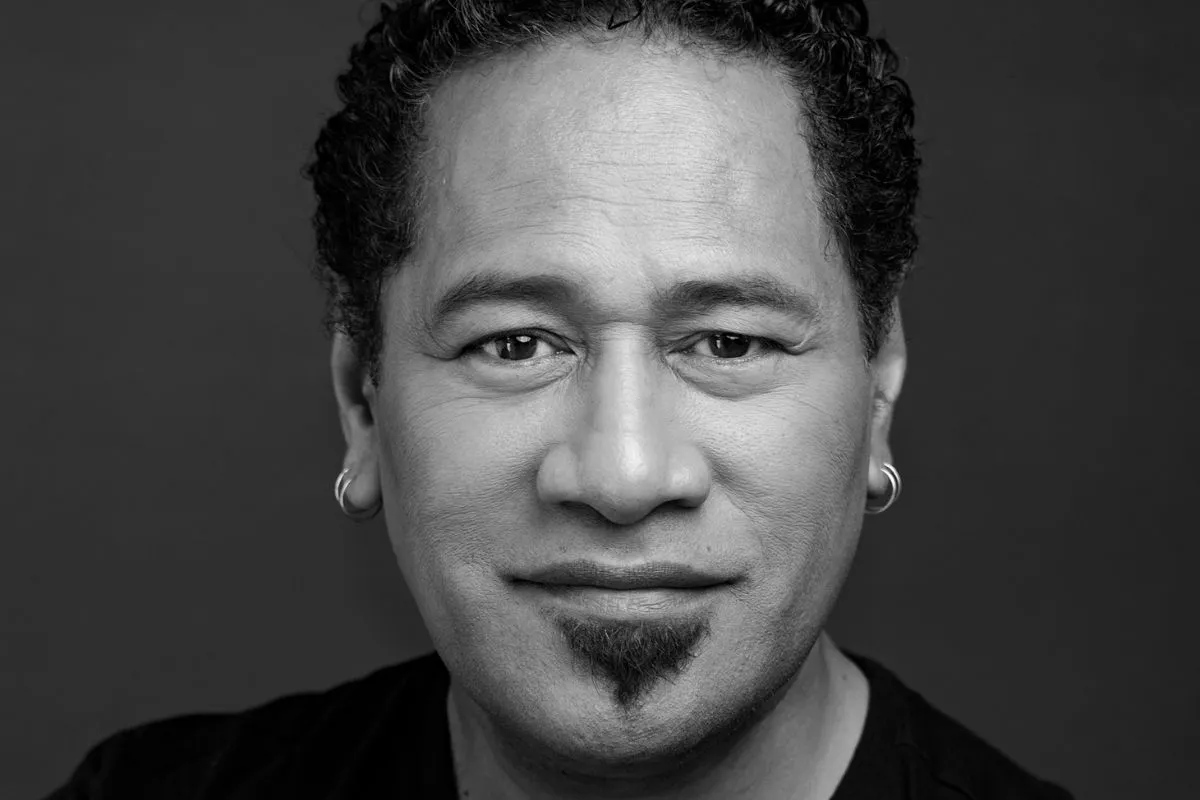
There are careers, and then there is Jay Laga’aia’s career. Star Wars. Home and Away. Water Rats. Play School. The Lion King. Wicked. Father of eight (yes, eight!). And now, Unscripted — an intimate evening of music and stories coming to the Adelaide Cabaret Festival this June. If it sounds like a lot, that’s rather the point.
‘Opportunity is a bus that rides on the road of success,’ Laga’aia says, with the easy authority of someone who has long since stopped second-guessing himself. ‘And we sit on a chair of what if. So, every now and again, you just got to get off and get run over by that bus. I’ve been very successful in being run over several times.’
It’s a philosophy that has served him well. When Laga’aia arrived in Australia from New Zealand in 1995 — fresh from filming Xena: Warrior Princess — he became the first Polynesian actor cast in a mainstream Australian drama. He’s characteristically matter-of-fact about the significance of that milestone. ‘I had made a deliberate decision that I wasn’t going to be that baby oiled skinned brown guy who sits in the corner and makes funny jokes. I wanted to be serious, to be an actor first and foremost and not an anomaly.’ History, he notes, is always significant once it’s passed you.
Play School is where a generation of Australians will know him best — and the show turns 60 this year, still doing exactly what it has always done. Laga’aia thinks the secret is representation as much as format. ‘People see a reflection of themselves — communities see themselves. They see Karen Pang, myself, Deborah Mailman, Justine Clarke. It’s a great opportunity to see people who look like the people that come pick up their kids at school.’ But the deeper magic, he believes, belongs to the parents. ‘We don’t ask you to join — we endow you with all of the bits and pieces to make the butterfly or the storybook or the finger paintings, and all of a sudden, the parents become the magic narrators, they become the wayfinders, the storytellers.’ The values haven’t shifted, he says. ‘Our house is still the same, but the meals are different.’ It’s one of the few shows, he adds, that you can walk out of the room and leave on.
Four decades in, Laga’aia speaks about resilience the way someone does when they’ve actually earned it — not as a concept, but as something learned slowly, often the hard way. The lesson that took longest? ‘Never equate applause to payment for your job, because you will always be disappointed.’ The one that changed how he works: less is more. A director sat him down early and told him he was jumping fences and stealing clothes — seeing something he liked on someone else’s washing line and grabbing it without understanding why it worked. ‘What you need to do is take that and grind it down to find its essence… and then make it your own.’
But the insight he returns to most — the one he presses into his own children — is less about craft and more about character. Allow yourself to be saved. ‘We are so insular,’ he says. ‘I was like that when I was younger, but then I realised, no. Because if they help me, then I can help them. It doesn’t mean it’s a sign of weakness. It just means that at this point in time, I do not know whether to go forward or back.’ It’s a disarmingly generous thing to hear from someone with his body of work — and perhaps that’s precisely the point. ‘They feel better because they’re of service,’ he says, ‘and then you can repay that later on to somebody else.’
He passes this thinking on to his children — several of whom have followed him into performance. His daughter Katie’s composure on the Moanastage drew public comment; Laga’aia wasn’t surprised. ‘It’s expected that you were polite on stage, and that you know your lines.’ She sat with the extras when she could have sat elsewhere, he says. Don’t change. His son is musical director on Unscripted itself. His daughter Georgia and colleague Vicky Falconer will also perform on the night. This is, deliberately, a family affair.
The show grew from a long-standing challenge from his manager — he’d turned it down three times before saying yes. What changed his mind was the format itself. ‘Unscripted is exactly what the show is,’ he says. Audiences can expect songs from home, stories from a life lived fully, and more than a little audience participation. ‘It’s about talking to your audience, getting them to do “head, shoulders, knees and toes”, but it’s also a reflection of who I am.’
What does he want people to leave with? ‘I want them to go away with the idea that they can do anything they want to. I want them to go away feeling like they forgot their lives for 90 minutes.’ And perhaps most of all, to have a conversation — about family, about the human voice, about why we don’t gather around and sing together anymore. ‘It was such a simple show, but the show resonated with us because it came from a place of love.’
Jay Laga’aia: Unscripted plays at the Adelaide Cabaret Festival, 4–21 June.
Tickets and information: