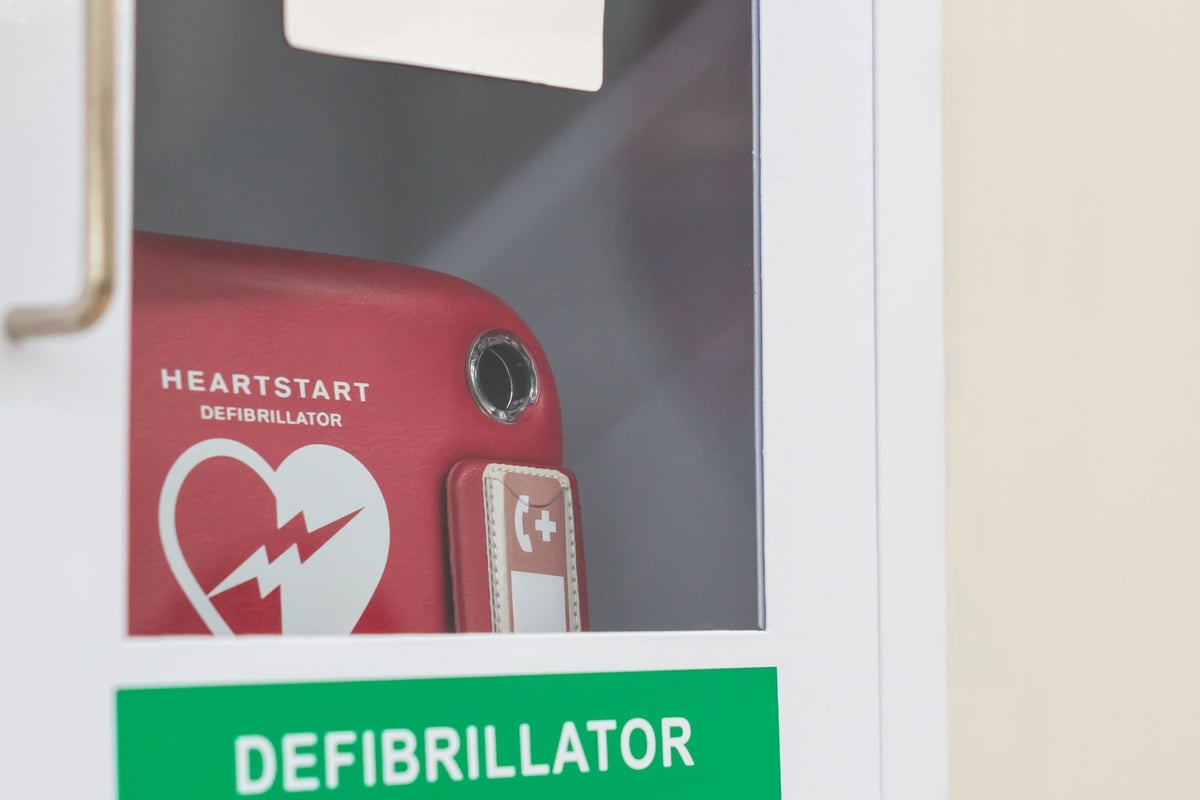
South Australia has led the nation on public access to defibrillators, and ahead of Restart a Heart Day on 16 October, St John Ambulance SA is asking what more can be done to save lives across the state.
The Automated External Defibrillators (Public Access) Act 2022, introduced as a private member’s bill by former MLC Frank Pangallo and backed by St John Ambulance SA, was an Australian first. Requirements for in-scope government buildings, facilities and emergency service vehicles came into effect in January 2025, with non-government buildings, facilities and prescribed public transport vehicles following in January 2026.
Now, St John Ambulance SA CEO Associate Professor Steve Morris and Mr Pangallo are looking at ways to extend that reach further into the community.
A defibrillator that fits in your pocket
One development is St John’s Pocket AED, a portable defibrillator about the size of a soft drink can. Unlike fixed-location units, it can be carried in a bag, pocket or glove box, bringing life-saving equipment closer to people on the move.
“South Australia has led the nation on public access to defibrillators, and now the Pocket AED gives us another way to bring the equipment closer to people on the move,” Associate Professor Morris said.
“First Aid and CPR training help people recognise an emergency and respond, and anyone can use an AED by following its prompts. The worst thing you can do is nothing.”
First aid training for learner drivers
Mr Pangallo believes advances in portable technology create an opportunity to build on the legislation through education. He’s advocating for first aid training to become part of the learning-to-drive process, helping new motorists respond in the crucial minutes after a crash or medical emergency while professional help is on its way.
“First aid training should be part of the learning-to-drive process, where learner drivers could learn how to use a defibrillator and perform CPR,” Mr Pangallo said.
“There are more than 32 countries in Europe that do this and thousands and thousands of drivers that are first aid-trained in cars, and if you have accessible AEDs you’ll have a generation of people who can perform CPR.”
Associate Professor Morris describes the potential as “life-saving herd immunity”, where widespread access to defibrillators and the skills to use them could dramatically increase the chances of survival during a cardiac emergency.
Follow Fifty+SA on Instagram and Facebook, and subscribe to our weekly newsletter.